
EXPERT INSIGHT
How 3D Tech Makes Healthcare Predictable and Accessible in Medtech


Personalization has quietly become part of our everyday lives. Streaming services, delivery apps, and GPS are just a fraction of the modern-day conveniences that provide tailored consumer content. And across industries, people no longer want one-size-fits-all solutions but products unique to who they are. The same treatment is expected in patient care as well. Where healthcare differs is that the stakes are higher, and the challenges are far greater.
The extraordinary case of the world’s first whole-eye and partial-face transplant is just one example of the impact of personalization. However, the procedure’s success raises a bigger question: how can the healthcare industry apply the predictability, precision, and planning from these unique cases and make them accessible for all — improving clinical workflows and patient outcomes? It all starts with harnessing 3D technology for mass personalization.
3D technology: giving surgeons the tools to rehearse surgeries virtually
More than 140 surgeons, nurses, and specialists treated Aaron James, the patient undergoing the whole-eye and partial-face transplant, with two surgical teams working on him and the donor simultaneously for over 21 hours. Astonishingly, that’s only half of the story.
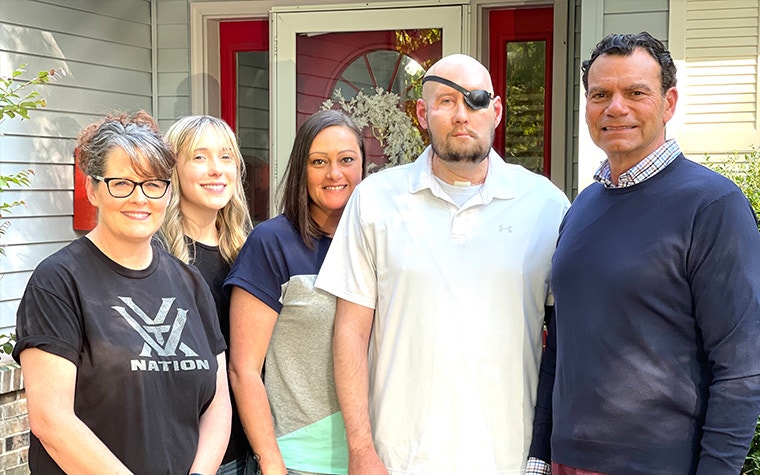
In the year leading up to the surgery, our clinical engineers worked with NYU Langone Health’s surgical team to create a virtual 3D plan of the operation, based on detailed CT imaging. This digital model allowed them to rehearse and evaluate multiple scenarios before setting foot into the operating room. As a result, 3D technology didn’t replace the surgeons’ skills; it amplified them, allowing the team to plan and execute the unthinkable with extraordinary precision. Aaron can now breathe normally, eat solid food, and take part in the world without hiding — simple acts we take for granted. This was largely thanks to collaboration and the predictability that 3D technology offers.
The case’s success highlighted the remarkable potential of 3D technology and made people look further ahead. What lessons could clinicians take from it for wide-scale personalized healthcare in the future?
The personalization trend: providing predictability and reassurance
With tools such as preoperative planning, digital modeling, and patient-specific instruments, the future is already here. Personalization is actively playing a vital role in improving case efficiency and postoperative recovery.
Every day, hip surgeries use 3D technology to improve surgical outcomes, with personalized implants designed to fit the patient’s anatomy and functional needs. In shoulder operations, surgeons can select the best-fitting implant from a range of standard sizes to achieve the optimal result. In both cases, personalization is essential for providing the clinician with the most appropriate tools for each case and supporting a patient’s recovery timeline — before, during, and after surgery.

Using tailored solution in these procedures makes a real difference during the planning and operational phases. Personalized aMace acetabular implants have given surgeons like Dr. Van Overschelde “very favorable outcomes” for decades, while case management platforms smooth communication between clinical teams, helping resolve any potential issues before surgery. For aMace’s 2,000 case, Dr. Van Overschelde's patient was back on their feet in days.
“At 7 am the day after the surgery, the 77-year-old woman was already standing and washing up at the sink. It’s a remarkable testament to the immediate impact of the implant and the procedure.”
Personalized implants gave this patient the ability to live without pain and limitations — and it can do the same for millions like her. At the same time as reassuring the patient, tailored implants mitigate clinical ambiguity and provide clarity for healthcare professionals throughout the process.

Clinical uncertainty is a significant issue, impacting patient comfort, surgical outcomes, and healthcare budgets. Conventional surgery has many variables that can cause uncertainty; this can translate into 30 – 45 minutes of lost time in the OR, contributing to nearly twice as many revisions that could potentially be avoided.1 By providing surgeons with virtual 3D models based on 2D medical images (instead of them visualizing the anatomy in their heads), these same surgeons could reduce the likelihood of revisions and even re-revisions.
Another surgeon who’s seen the impact of tools like 3D planning first-hand is Dr. Renaat Coopman, Head of the Department of Oral and Maxillofacial Surgery at Ghent University Hospital. He estimates, “In some cases, we’ve saved up to six hours in the OR. That’s a massive difference for the patient waking up from anesthesia — you cannot underestimate the impact.” The monetary costs are also significant.
Healthcare systems are under enormous financial pressure. Across OECD countries, healthcare spending already accounts for around 9 – 10% of GDP,2 and aging populations will push that figure even higher. By 2050, there will be around 52 people aged 65+ for every 100 working-age adults (aged 20 – 64).3 These patients will need more care and long-term support. Personalized implants seem more expensive than standard ones in the short term, but could be more economical when revisions and re-revisions are factored in over the long run.
When it comes to hip replacements, for example, up to 27% of hip revisions are re-revisions due to a suboptimal fixation. Also, re-revisions are three times more likely to fail compared to the first revision.4 Fewer procedures with greater accuracy benefit patients and surgeons, which relieves the strain on healthcare systems.
Personalized planning and patient-specific implants support the first-time-right principle. The surgeon enters the operating room better prepared, with greater precision and predictability. This reduces surgery time, lowers the risk of complications, and decreases the likelihood of revisions — all of which are major cost drivers in healthcare. Long-term care alone already accounts for around 1.8% of GDP and continues to grow,5 so the total cost of care (TCC) must be considered.
“At 7 am the day after the surgery, the 77-year-old woman was already standing and washing up at the sink.”
— Dr. Philippe Van Overschelde, Orthopedic Surgeon, Hip and Knee Clinic
Looking at the entire care pathway TCC leads to the conclusion that personalization is not simply an added cost; it can be a smarter use of resources, improving outcomes while reducing TCC. Making personalized care more accessible and affordable is possible; it just needs a shift in perspective.
Instead of choosing between one-size-fits-all efficiency and one-off customization, digital technologies combine both. Design can be adapted to each person, while production remains efficient, repeatable, and scalable. In healthcare, this means moving beyond treating the average patient and making individualized care available to thousands — and ultimately millions — of people.
Hospitals understand the benefits of personalization and have started adopting 3D printing and planning onsite, at the point-of-care. These point-of-care facilities are rapidly becoming integral to everyday clinical practice. What started as a technology embraced by early adopters is now transitioning to broader global implementation. This ability to visualize and plan marks a profound shift — from understanding the human body to understanding the unique patient. Advancements in automation, AI, and operational efficiency fuel these breakthroughs. The next quantum leap in mass personalized healthcare will involve predictive modeling, extended reality (XR), and bioresorbable materials.
Looking ahead: real-time visualization, data-driven surgery, bioresorbable implants
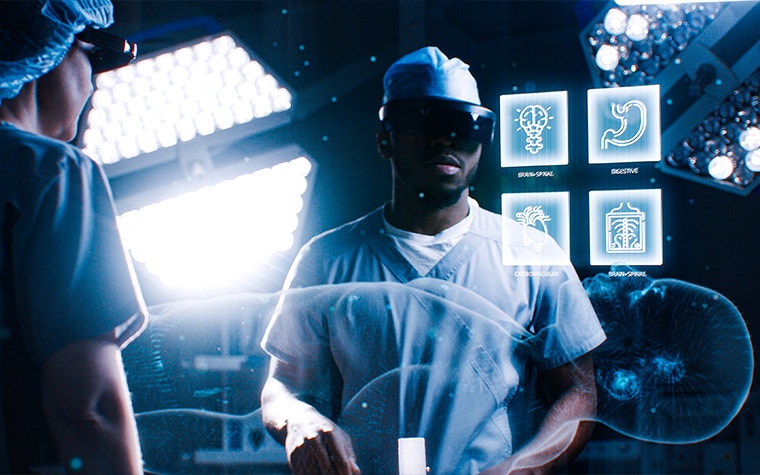
Today, 3D technologies are increasingly combined with XR. Overlaying digital models directly onto patients provides surgeons with instant visual guidance, enabling them to operate with precision. And intraoperative imaging can be compared instantly with the original plan, allowing surgeons to adjust in real time. Virtual planning, along with patient-specific guides, is making CMF procedures, such as cranial vault reconstruction in children, more predictable. In effect, modern surgery is becoming more precise, visual, and data-driven. However, 3D technology can go even further.
Companies are already pushing the boundaries of traceability and repeatability by producing small series of biocompatible single-use components for pharmaceutical production. But what if healthcare professionals could track and implant specific, bioresorbable solutions into the body? These implants could temporarily support the body and then gradually disappear as the body heals. This would transform not only what we produce but also the way surgeries are performed. Bioresorbable implants may seem like something far off, but trials are happening as we speak.
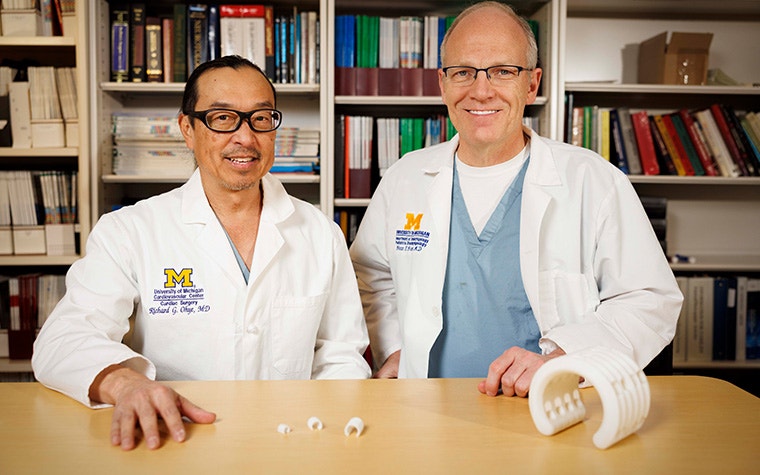
3D-printed synthetic splints made from bioresorbable materials for children have entered FDA clinical trials. And over the next eight years, at least 35 infants and children will be enrolled. Each personalized tube will be printed at our Michigan facility, with insights from the trial paving the way for new treatments in soft-tissue reconstruction across cardiology, pulmonary care, and breast reconstruction. These developments are scratching the surface of what’s possible.
On the horizon is the possibility of bioprinting, or printing living tissue like cartilage, skin, and organs using living cells. While this may seem impossible, the same was said about Aaron’s whole-eye and partial-face transplant. Reconstructing individual parts of the anatomy is already possible; the next step is regenerating personalized parts affordably and at scale. This future is closer than we think.
L-105439-01
1 Orthognathic surgery — Heufelder, Ellis, and Guzel
2 OECD: Health at a Glance 2025
3 OECD: Rapidly ageing populations will continue to put pressure on pension systems
4 Swedish Arthroplasty Register, Annual Report 2014
5 A-Mark Foundation: How Is Long-Term Care Handled by OECD Countries?
Share on:


You might also like
Never miss a story like this. Get curated content delivered straight to your inbox.