
EXPERT INSIGHT
The Hidden Challenges Behind Medical Device Companies' Self‑Made Clinician Portals


In many medical device companies, building an online platform for clinician communication doesn't begin as an intentional strategic decision. It's a fallback response to growth.
Your case volumes increase. Communication with hospitals becomes harder to manage. Surgeons ask for clearer status updates, faster approvals, fewer emails and attachments, and no misunderstandings. At some point, it becomes undeniable: you need a proper platform for this.
For product managers, building that system seems like a logical next step. Improving collaboration with clinicians directly affects turnaround time, customer satisfaction, and ultimately, patient care.
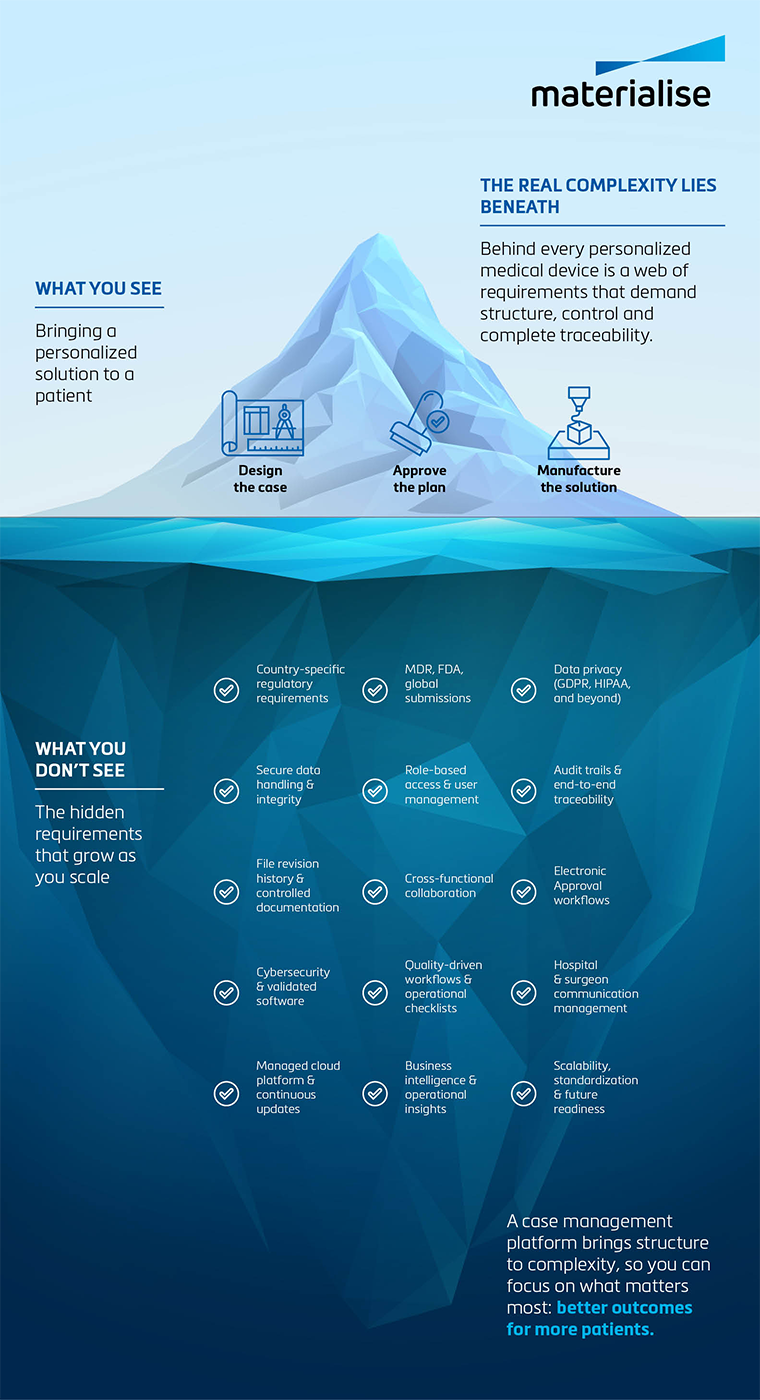
What's rarely considered at that point is where this path tends to lead. The challenge is not only what the platform needs to do today, but whether it can continue supporting the business once volumes rise, teams expand, and customer expectations increase.
The platform's growth spiral
At first, the platform is clearly outward-facing. It receives patient data, guides clinicians through approvals, and provides visibility into case status. The scope feels contained, and the roadmap is achievable. All the work fits neatly into a product plan.
But as your medical device business scales, users find more potential in the platform.
Engineers begin relying on it for efficient access to case data. Internal handoffs align with clinician portal views to reduce friction. Over time, more tools and functions are added, not because that was the initial ambition, but because it seems like the fastest, safest solution.
This shift often takes form in small, reasonable requests. Say an engineer asks whether they can embed standard operating procedures into the workflow. Or maybe a quality manager would like to store approval timestamps centrally for traceability.
Gradually, your platform changes role. It's no longer just a way to communicate with customers. Now, it's the place where cases are processed and decisions are recorded. What started as a tool supporting the business has now become a tool the business is dependent on.
At this point, your team will probably realize that building this platform was just the beginning. And if that realization only happens after demand has already accelerated, making major changes becomes far more disruptive. Instead of fully focusing on market adoption and meeting demand, teams can end up navigating complex change management at the same time.
Where the real work begins
Once your internal operations depend on the platform, every update carries more weight, and each improvement has consequences beyond user experience. Now, changes need validation, documentation, and regulatory review.
Crucially, data privacy and security are no longer abstract requirements; they're daily concerns. Product managers must begin considering who can access which patient data, how long information should be retained, and how access is logged and reviewed. One seemingly simple question, such as whether a hospital user can view historical cases, can trigger a cascade of follow-up questions around audits, role-based access, and accountability.
Yet, the platform needs to serve all its various audiences properly. While clinicians require clarity and ease of use, internal engineers want depth, flexibility, and traceability. Deciding who has access to what becomes more complex and harder to change later.
Security conversations evolve as well. You'll need answers to how data is encrypted in transit and at rest, how privileged access to systems is controlled, and how security incidents would be detected and handled. For all of which, hospital IT departments, auditors, and internal quality teams require precise answers.
Add scale to the equation, and complexity compounds. More hospitals mean more variation, and higher case volumes expose edge conditions that weren't visible early on. Approaches that worked well for the first customers begin to strain, making it a constant challenge to maintain stability while accommodating change. At the same time, teams start looking to automation to reduce manual effort, speed up case progression, and keep collaboration moving without delays.
Terumo Aortic experienced this pressure firsthand as demand for their personalized stent-graft business skyrocketed. To support physicians while maintaining operational efficiency, they opted for a proven online case management platform instead of developing their own. In this on-demand webinar, you can learn more about the challenges they faced and what led them to this decision.
When "build vs. buy" is no longer the question
By this stage, a new question arises: "What will come of this platform moving forward?"
Operating a platform like this is not a one-off investment. It's a long-term commitment to compliance, security, maintenance, and evolution under regulatory pressure. Product capacity will not only be dedicated to differentiation, but also to keeping the underlying system reliable and compliant year after year.
For many product managers, this realization sets in when business impact becomes impossible to ignore: a market release delayed because country-specific regulatory requirements demand additional documentation, a security assessment that introduces new action points, or a hospital asking for proof of compliance with standards such as ISO 27001 for information security or ISO 27701 for privacy information management.
Roadmaps slowly fill with essential work that's necessary just to keep up with these new demands. Teams are forced to make difficult choices. Do you invest in new product capabilities or shift resources towards security updates, compliance remediation, and platform maintenance? Trade-offs become harder, and progress on the core medical offering slows, even as your team works harder than ever.
At that point, the cost is no longer just technical. Time-to-market slips, business priorities get reshuffled, and R&D and engineering resources are pulled from customer needs into sustaining the platform itself. This is where you've officially moved past the "build vs. buy" question. Now, you need to ask yourself whether your organization should commit to operating a regulated platform or redirect efforts elsewhere.
Rethinking your platform
Starting your clinician portal from an existing platform doesn't mean giving up control or ambition. For personalized medical devices, it means acknowledging that certain layers of complexity are inevitable. It also means recognizing that future-proof case management is easier to establish early than to rework later, once case volumes are growing.
A mature platform is shaped around principles such as data protection, role-based access control, fixed data storage, continuous monitoring, and documented incident response processes. These are not capabilities you can easily "add later." They influence architecture, workflows, and day-to-day operations from the start.
For product teams, this maturity offers space to focus on improving the solution instead of platform development. Your system can evolve without every change posing foundational risks.
Learning from mature platforms
Materialise Mimics Flow emerged from this exact reality. It wasn't designed as a theoretical solution; it was shaped over more than 15 years of internal and external personalized case management. During that time, it supported close collaboration with clinicians while simultaneously serving as a backbone for internal engineering workflows — all within a continuously evolving regulatory landscape.
Today, the platform operates within an ISO 27001-certified information security management framework and aligns with ISO 27701 principles for privacy information management. Data is encrypted both in transit and at rest, access to sensitive information is tightly controlled and monitored, and detailed audit logs trace who viewed or modified patient data and when. The value of these capabilities only becomes clear once a platform is deeply embedded in your everyday operations.
The platform’s maturity is also reflected in how it supports long-term growth. With flexible pricing that adjusts alongside a company’s growth, businesses pay only for what they need and customize case bundles to suit the required quantity and timeline. Licensing can also be aligned with operational demands, giving teams access to the features and resources they need as the organization expands.
This history matters because it means the platform doesn't remove complexity — it absorbs it. The hard lessons have already been learned, and Mimics Flow Case Management has evolved accordingly.
Choosing a long-term strategy
Every medical device company will end up with a platform as it grows. The key consideration is how much of your organization's future you want it to consume. And making sure you tackle this consideration early.
If your competitive advantage lies in the medical value you deliver, and not in maintaining regulated infrastructure, then opting for a solution that's already grown into that role can be a strategic choice, not a compromise.
L-105373-01
Share on:


You might also like
Never miss a story like this. Get curated content delivered straight to your inbox.