
EXPERT INSIGHT
Why a Case Management Platform Is an Operational Necessity, Not a Nice-to-Have for Personalized Medical Device Companies
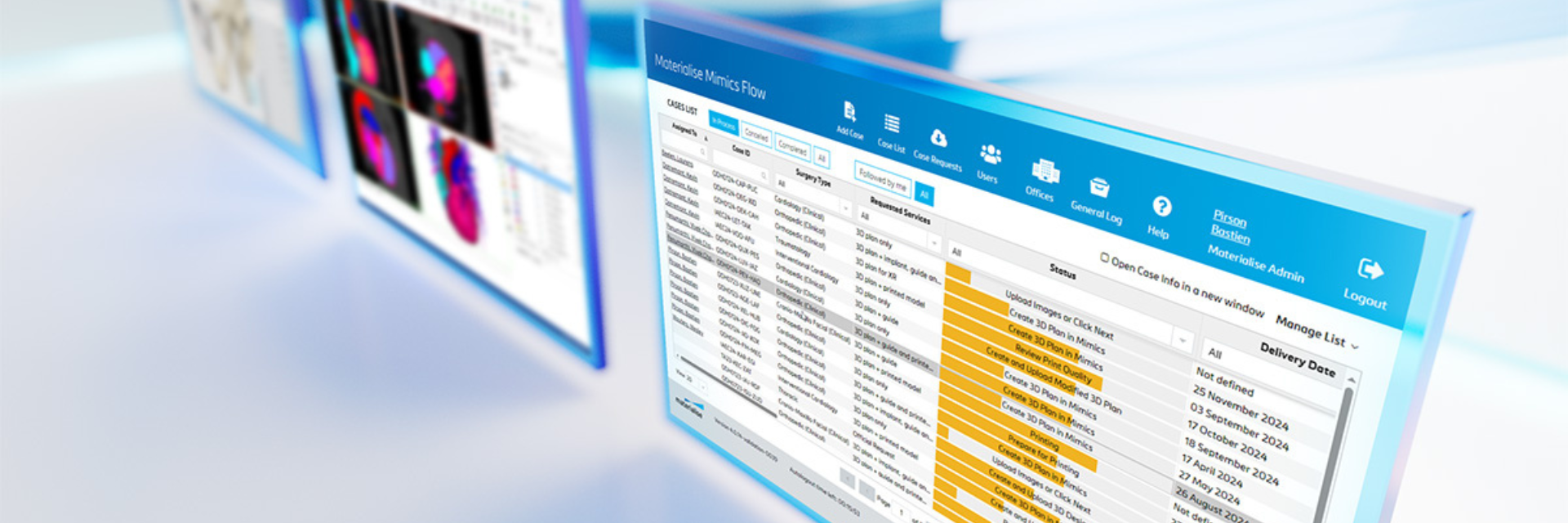

In the start-up phase of a personalized medical device business, the day-to-day operations run quite smoothly without a formal structure in place. Cases arrive by email, files are shared through basic data transfer platforms, and engineers know which surgeon to call when processes are unclear. Product, operations, and engineering teams keep everything ticking — mainly through trust, experience, and informal coordination. And this only works up to a point. But when complexity increases, case volumes grow, and the business wants to scale while adhering to data privacy and security requirements, your previous way of working begins to show its limitations. The company’s ad hoc approach to case handling creates bottlenecks rather than solutions.
If you’re moving from feasible case volumes to sustained growth, this sounds all too familiar.
When personalization scales, coordination becomes the real challenge
Your current tools weren’t designed for personalized medical device workflows
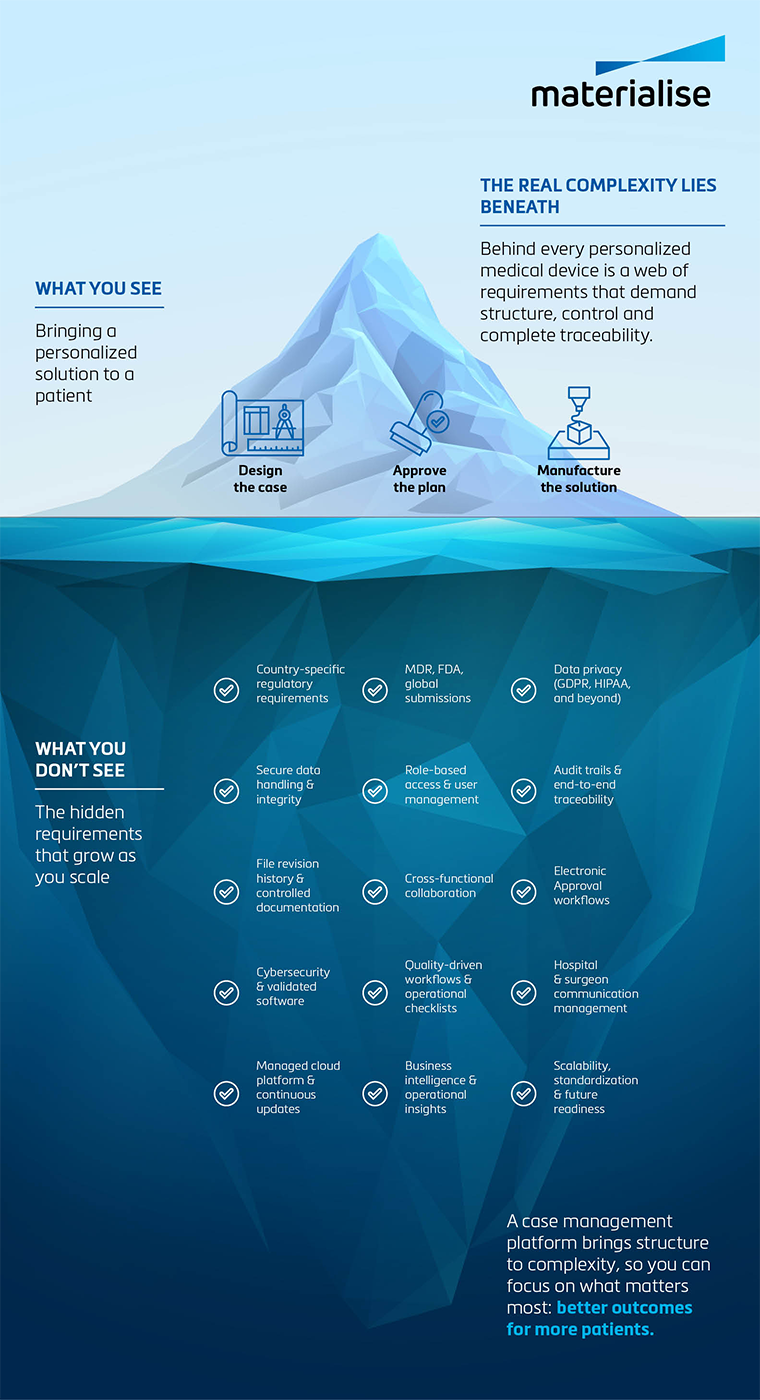
The complexity surrounding personalized medical devices is very different from that of traditional products. Cases are unique, patient datasets are different, and clinicians bring their own preferences, timelines, and expectations. As long as volumes remain low, teams manage to absorb this variability manually. But as cases increase and personalization scales, coordination — not engineering — becomes the primary constraint.
Occasional questions start to resurface daily, such as, “Which version of the data is current?” or “Has the case been approved, and by whom?” These questions don’t arise because people are careless. They become more apparent because information is thinly spread across tools that weren’t meant to support end‑to‑end case workflows.
Most companies build a structure gradually, using existing tools such as email, shared folders, and spreadsheets, while internal systems support engineering work. Each tool solves a local problem, and together, they create something workable but fragile.
The balance shifts when more stakeholders are involved — surgeons, hospital staff, internal engineers, quality teams — making workflows and processes almost incomprehensible. Teams duplicate information. Context disappears quickly. And decisions are made based on partial or outdated data. This results in teams trying to compensate for these shortfalls by adding more people or rules. And often, these additions increase handovers, and the risk of delays and errors — eroding, not improving outcomes.
What’s the hidden cost of ad‑hoc case handling?
A lack of predictability, clarity, and visibility
Without predictability, hospitals need clarity on next steps. Surgeons seek confidence that approvals are handled correctly. Internal teams need shared priorities and clear responsibilities. And leadership teams need visibility into how cases are moving when they’re slowing down and the reasons why.
Without a shared way to manage cases in an end-to-end workflow, each need is addressed in isolation, and scaling becomes dependent on individual effort rather than a repeatable structure.
Over time, this subtle change doesn’t just slow teams down; it makes growth harder to manage. The result? Planning becomes reactive, bottlenecks are discovered too late, and delivery commitments feel harder to predict, even when teams are working at full capacity and doing the right things. Handling data securely to meet regulatory standards becomes almost impossible for teams. And the risk of missing deadlines increases as lead times expand. Consequently, growth stalls because coordination is no longer visible or consistent.
That’s why a case management platform is a necessity, not a nice-to-have. It reduces friction for clinicians and internal teams, prepares organizations for growth without overengineering, mitigates the risk of non-compliance, and builds a solid foundation for growth before complexity multiplies.
Case management platforms provide a new way of working
Gain accessibility, traceability, and consistency in one coherent flow
A case management platform is not just another tool layered onto your existing workflows. It’s a way to de-risk your operations, providing a shared system of record for every case in your business. A secure, operational case management platform connects clinical input, internal processing, and approvals into a single clear thread. Information no longer lives in boxes or scattered files. Instead, it’s accessible to the right people at the right time, with context and data privacy preserved as cases move forward and personalization scales.
For clinicians, this means clearer communication and better visibility. Internal teams also benefit, as it reduces ambiguity and unnecessary handovers. And for organizations, it introduces predictability into how cases move, from intake to delivery.
And more importantly, a platform that offers collaboration software makes growth more transparent and easier to manage. Bottlenecks are identified, processes are improved intentionally, and variations are managed rather than absorbed.
Many companies see a case management platform as something to optimize or consider once growth accelerates. The opposite is true. It often becomes necessary earlier than expected. This is because personalization increases the number of interactions, approvals, and dependencies per case — not just the case volume.
Additionally, waiting for the first signs of friction before considering a proper case management platform can be detrimental. The costs involved, such as the cost of change and overall change process, will be substantially higher, consuming precious resources that should be dedicated to meeting market demand for your devices. That’s why the project should be planned as soon as possible, particularly when it’s clear that commercialization is just around the corner.
Furthermore, proactively establishing a platform provides the structure needed to support medical device case coordination and data handling, simplifying complexity without requiring superhuman effort or relying heavily on individual knowledge. And it allows teams to scale collaboration and cases efficiently without risking non-compliance or overall output.
Your foundational structure is just the beginning
The choice is clear, but what comes next?
Once your case management platform is in place, it’ll quickly become central to your daily operations. The platform influences how teams collaborate, data flows, and decisions are made.
But when these elements fall into place, a new set of questions inevitably emerges:
How should this platform evolve as the business grows?
- What sort of responsibilities come with operating it over time?
- Who should manage this complexity, and should we manage it ourselves?
These questions should, ideally, be addressed before the platform becomes indispensable.
In the next article in this series, we’ll explore what happens when a case management platform transitions from a supporting role in an organization to an operational backbone — and why many companies underestimate what that shift really entails.
L-105372-01
Share on:


You might also like
Never miss a story like this. Get curated content delivered straight to your inbox.