
EXPERT INSIGHT
Predictive Simulation in Left Atrial Appendage Occlusion: Evidence for Improved Precision and Procedural Efficiency

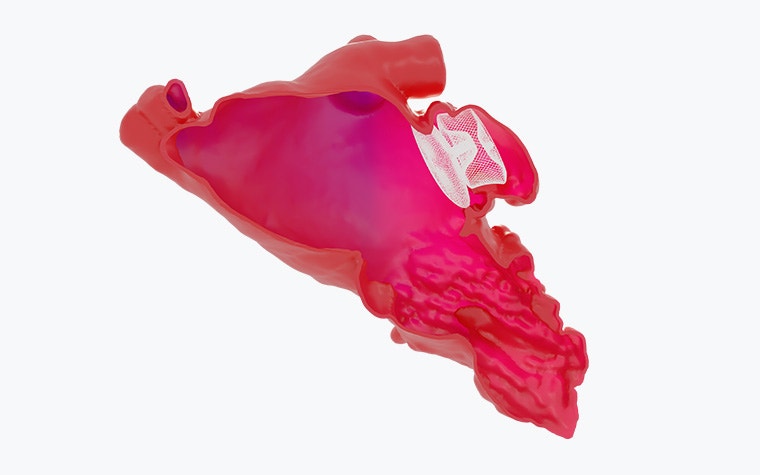
For an interventional cardiologist, the ability to predict the success of a left atrial appendage occlusion (LAAO) is essential for delivering precision care. Procedural safety and success are non-negotiable when taking this measure to prevent strokes in patients with atrial fibrillation and at higher risk for blood clots. Every decision must be guided by the goal of minimizing risk. Predictive simulation bridges the gap between clinical planning and procedural success, offering in-depth insights to reduce risks and improve efficiency. Here, we review three pivotal studies that validate the impact of simulation-based planning for LAAO, using FEops’ predictive simulations.
Establishing evidence for predictive simulation
The PREDICT-LAA trial, led by Dr. Ole De Back from Rigshospitalet in Copenhagen and Dr. Philippe Garot from the Paris South Cardiovascular Institute, was a prospective, multicenter, randomized, controlled study evaluating the clinical and procedural advantages of AI-driven, CT-based computational modeling in LAAO planning for 200 patients across 10 centers in Europe and Canada.
Compared to standard planning, the AI-driven approach delivered measurable improvements in procedural efficiency and precision:
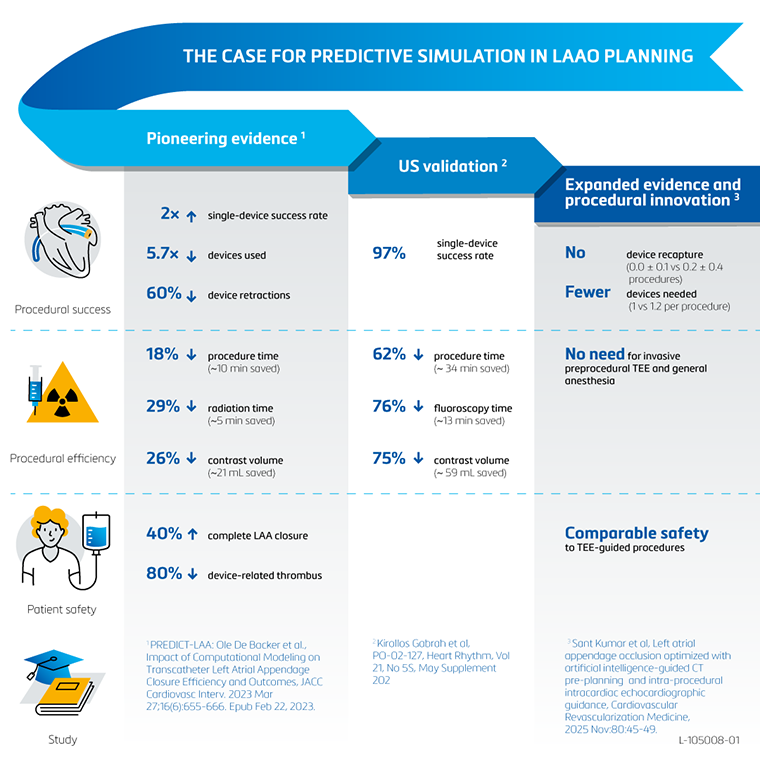
- 2x procedural success with a single device and deployment
- 40% increase in complete LAA closure without residual leaks
- 60% reduction in device retraction
- 80% lower risk of device-related thrombus
- 5.7x fewer devices used — only 3% of procedures required more than one device, versus 17% in the control group
- 18% shorter procedure times — an average gain of 10 minutes
- 25% reduction in radiation time and contrast volume
This trial was the first ever randomized clinical trial evaluating the impact of predictive simulation on procedural efficiency and precision. It marked the first validation of predictive simulation as a tool to optimize LAAO planning and laid the foundation for further studies.
Confirming results in the US
Building on the success of the PREDICT-LAA trial, a team led by Dr.Devi Nair from St. Bernards Heart & Vascular in Arkansas, USA, conducted a study to confirm these pioneering findings. This research confirmed previous study results and demonstrated the scalability and reliability of simulation-based planning in diverse clinical settings for the Abbott Amulet™ and Boston Scientific FLX™ devices:
- 97% success rate with single-device implantation, as predicted by AI-driven simulation of device deformation and sizing
- 62% shorter procedures, saving around 34 minutes
- 76% less fluoroscopy time, saving around 13 minutes
- 75% less contrast volume, saving around 59 mL
This additional validation strengthened the case for predictive simulation as a key enabler of efficiency and precision in LAAO procedures, paving the way for adoption across clinical practices.
Expanding the evidence base
A third study led by Dr. Ashish Pershad from Chandler Regional Medical Center in Arizona, USA, further reinforced the advantages of predictive simulation, focusing on procedural safety and efficiency.
The team compared transesophageal echocardiography (TEE)-guided procedures with CT-based predictive simulation combined with intracardiac echocardiography (ICE)-guided procedures, measuring differences in device use and procedural outcomes, respectively:
- 0 device recaptures compared to 1 in 5 recaptures in ICE-guided procedures (0.0 ± 0.1 vs. 0.2 ± 0.4, p = 0.001)
- 1 device needed per procedure vs an average of 1.2 in ICE-guided procedures
- Comparable safety results
- Potential to reduce adverse events and improve procedural efficiency by eliminating the need for invasive preprocedural TEE and general anesthesia
Once again, these results add to the growing evidence supporting predictive simulation as a powerful tool for improving procedural success and safety, making it indispensable for modern LAAO planning.
A new era of precision in LAAO
The combined findings from these three studies demonstrate that predictive simulation is more than a tool — it’s a paradigm shift in procedural planning for LAAO. By driving efficiency, accuracy, and improved patient outcomes, this technology empowers clinicians and medical device companies to set new standards for success.
With FEops’ predictive simulations, we’re driving this shift in daily practice, offering AI-driven solutions that enable confident decisions every step of the way.
L-105004-01
- PREDICT-LAA: Ole De Backer et al., Impact of Computational Modeling on Transcatheter Left Atrial Appendage Closure Efficiency and Outcomes, JACC Cardiovasc Interv. 2023 Mar 27;16(6):655-666. Epub Feb 22, 2023.
- Kirollos Gabrah et al, PO-02-127, Heart Rhythm, Vol 21, No 5S, May Supplement 202
- Sant Kumar et al, Left atrial appendage occlusion optimized with artificial intelligence-guided CT pre-planning and intra-procedural intracardiac echocardiographic guidance, Cardiovascular Revascularization Medicine, 2025 Nov:80:45-49.
Share on:



Biography
Ole De Back

Biography
Devi Nair

Biography
Ashish Pershad
You might also like
Never miss a story like this. Get curated content delivered straight to your inbox.