
EXPERT INSIGHT
The Metal 3D Printing Opportunity for Aerospace Companies
Gaylord Klammt, Materialise

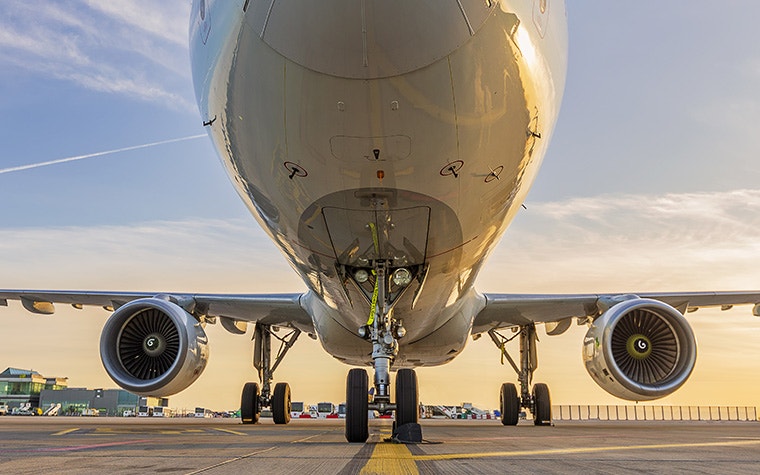
Metal 3D printing can help aerospace companies overcome common pain points, create new value for customers, and bring new strengths to existing technologies. Gaylord Klammt, Metal 3D Printing Director at Materialise, explains why it’s an important opportunity for the industry, and how our Metal Competence Center can help you take advantage of it.
If you’re familiar with the basics of metal 3D printing, you likely already know its benefits. Many of them feel tailor-made for aerospace: design freedom, lightweighting, a buy-to-fly ratio that traditional manufacturing techniques can’t match, and short lead times, to name a few.
Likewise, the ideal applications match up well. Lightweight structural brackets, complex ducts — essentially, any time your project involves complexity, weight reduction, or part consolidation, additive manufacturing can deliver.
The metal 3D printing opportunity
These characteristics make additive manufacturing a pivotal solution for decision-makers in the industry, especially those facing common challenges like long lead times for spare parts, obsolete tooling, slow, complex supply chains, and high-volume, low-mix demand. If adopted correctly, additive manufacturing enables local, on-demand production and supply chain resilience, soothing those pain points and creating a competitive advantage.
And that’s really just the tip of the iceberg. Beyond spare parts, aerospace companies can reap the rewards of redesigning existing components — benefits like extended life times, improved performance, reduced aircraft downtime, and value-added repair or upgrade solutions.
Together, those benefits have a positive impact on both economic and environmental sustainability, too. Lighter parts burn less fuel. 3D-printed parts consume less material. Producing locally limits transport emissions and improves supply chain security. Longer-lasting, repairable parts reduce waste and downtime.
As governments and the aerospace industry itself begin to prioritize sustainability goals, metal 3D printing can quickly become an invaluable tool.
Metal 3D printing today
With all that in mind, it’s not surprising that more and more companies have adopted the technology in recent times. Currently, they’re primarily focusing on low-risk, low-criticality applications, like spare parts, tooling, and support equipment.
After all, the technology is still developing. Advancement in this industry runs on data, so while the most carefully regulated parts may seem out of reach right now, I believe even that will change in the future. In fact, it is changing — engineers are getting more experience and gathering more data. Different parts are coming. Big OEMs are using it. They’re creating their own confidence with metal 3D printing.
As the technology matures, we’ll likely see those applications evolve to include flight-critical applications. For that to happen, companies across the industry need to have confidence in the technology, backed by data from specimen tests, standardized qualification approaches, stable processes, and digital traceability.
How can you take advantage of metal 3D printing?
I’d summarize the journey into five main tasks or milestones:
- Identify suitable applications, like those I mentioned above
- Build your internal AM competence — bring experience in-house, try, test, and gather data
- Work with experienced partners
- Develop qualification and approval pathways
- Integrate 3D printing into your existing qualification pathways
You’ll quickly notice that this list includes both technological and cultural points. In my opinion, each is equally important — without the right mindset, your progress will be limited. And that goes both ways; as point 5 suggests, it’s not all-or-nothing with metal 3D printing. You need the best of both worlds.
What do I mean by that?
What I like, and strongly encourage, is to always have an open mindset. Consider both traditional and additive manufacturing, combine their strengths, get everybody on the same page, and you’ll deliver the best results for your customers.
Your partner for additive manufacturing in aerospace
At Materialise, we have a proven history of driving the growth of additive manufacturing, and our Metal Competence Center is at the heart of it all.
When we talk about our site in Bremen, we often refer to it as our hub of industrial-grade metal additive manufacturing. Our customers can expect certified production, engineering expertise, in-depth knowledge of 3D printing materials, and post-processing facilities, all under one roof. It’s proof that we’re much more than just a manufacturer.
But to me, it’s much simpler than that — and much more valuable to the aerospace industry.
We have the right people, with the right skills, with the right knowledge, with the right data.
As projects or customer requests become more complex (the norm for industries like aerospace), this combination becomes essential. Customers can access our data lake, filled with thousands of data points from hundreds of builds, analyze that information, and use it to drive decision-making. They can co-create value that doesn’t yet exist with experts in additive manufacturing and take a project from start to finish with a single partner. That’s real value.
Then there’s the connection between our different departments. Our R&D department works closely with the industry through projects like SONRISA and even more closely with our production department. That team provides internal support to continuously improve our production processes, helping us deliver better services and better results for our customers. That’s real value.
When we bring this all together, using the benefits offered by these two departments, we can raise new R&D projects within the aerospace industry and get in contact with our customers from the earliest stages.
Putting customer needs first
Of course, I can’t talk about production without mentioning our qualifications. At the end of 2024, Materialise earned the EN 9100 certification for metal parts. It’s an important addition to the existing certifications we have across our production sites, such as ISO 9001 and EASA 21.G in our HQ production site. That importance is reflected in the trust shown to us by customers like Airbus, with whom we have worked for many years, and by other Tier 1s, Tier 2s, and OEMs.
Needless to say, these qualifications are essential for any manufacturer in highly regulated industries, but they’re only the foundation of what we want to achieve.
What’s really important to us at Materialise is specific customer requirements and qualification programs. After all, every customer has their own needs and understanding of these qualifications, and they’re experts in their field. By understanding precisely what you need, we can find ways to fulfill it through our ideas and experience, then deliver the right quality, at the right time, and within budget.
With this approach, we take on the role of an enabler, lowering barriers to entry and reducing risk while combining our expertise with yours.
Share on:



Meet the author
Gaylord Klammt
You might also like
Never miss a story like this. Get curated content delivered straight to your inbox.