
EXPERT INSIGHT
Exploring the Future of Thoracic Surgery: Overlaying 3D Models onto Intraoperative Video

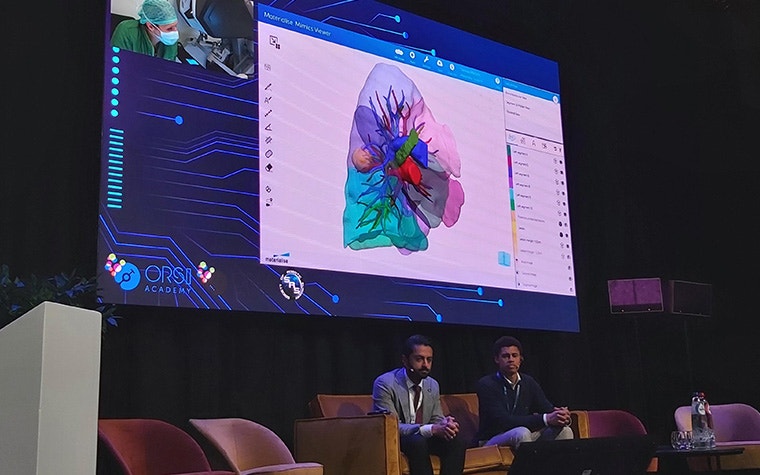
Innovating the future of patient care is at the heart of the University Hospital of Leuven’s ethos. As a pioneer in healthcare, the hospital is renowned for its innovation across disciplines, including endometriosis and artificial intelligence applications. Its thoracic surgery department is no exception. Supported by advanced technology from Materialise, Orsi Innotech, and NVIDIA, the team is exploring how surgeons can gain deeper insight into complex lung anatomy, with the aim of improving surgical planning, execution, and outcomes through augmented reality.
The vision: precision in complexity
Thoracic surgery demands meticulous planning and execution, particularly for cases of lung cancer resections or patients with prior interventions. Each patient’s anatomy is unique, and surgeons face the constant risk of impacting vital structures such as arteries, veins, and bronchi. Additionally, surgeons aim to resect a safe margin surrounding the tumor to prevent recurrence while sparing as much healthy tissue as possible.
With these challenges in mind, Prof. Dr. Yanina Jansen and Prof. Dr. Lieven Depypere sought a method that offers surgeons a deeper understanding of their patients’ anatomies before and during surgery, enabling them to precisely perform the resection as planned with confidence and efficiency. Dr. Jansen emphasized the significance of this in intricate cases: “The more complex the segments, the more important your 3D image is.”
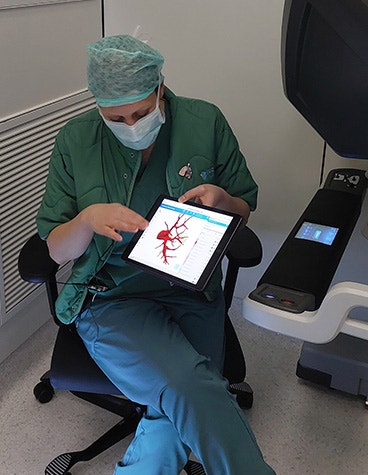

The UZ Leuven Thoracic team sees opportunities in integrating 3D planning and overlay technology with surgical robotics to further enhance surgical precision.
This goal led them to explore the impact of 3D planning for thoracic surgery and overlaying the resulting 3D models over endoscopic images during surgery. While Orsi Innotech’s AR overlay technology is still in the research phase, this innovative method, combined with advanced 3D planning, has enormous potential value for every lung cancer procedure, from routine to exceptional.
Intraoperative tools like this offer surgeons guidance in real time, precisely achieving the resection as planned and helping them see critical anatomical structures, such as vessels, to prevent bleeding. They also serve as a reference if the anatomy is non-standard — seen in one out of three cases — or unexpected challenges arise. Dr. Depypere explained, “If you have doubts preoperatively, then it’s nice to see the plan during surgery as well. It gives you more clarity.” Although experimental, this method offers real promise.
Lessons from the operating room
The team applied this technique to real surgical cases, gaining valuable experience with its value and potential applications. In this case, which was broadcast live during the Orsi Surgical AI Days conference, the team evaluated a lesion near the boundary of two lung segments. Using 3D planning, they pinpointed its exact location and determined whether it was necessary to remove one or two segments. Dr. Jansen shared, “For this case, 3D planning offered more insight. We completed the procedure while preserving as much healthy lung tissue as possible.” This clear view of the patient’s unique anatomy before the operations allowed for more informed and personalized decision-making.
Beyond preoperative clarity, intraoperative assistance provided reassurance throughout the procedure. Dr. Jansen explained, “We were pretty confident that the issue was resolved and we had everything under control, yet we regularly looked back at the 3D image just to ensure we didn’t miss anything.”
A unified effort for innovation
The success of this research results from close collaboration between surgeons, radiologists, and engineers from Orsi Innotech and Materialise. It shows great promise in providing surgeons with more confidence, all to ultimately maximize healthy tissue and improve patient outcomes.
Looking ahead, the team sees opportunities to integrate 3D planning and overlay with other technologies. For example, advancements in robotics and haptic feedback could further enhance surgical precision, while tools like perfusion-ventilation analysis could make it possible to more accurately predict post-operative lung function.

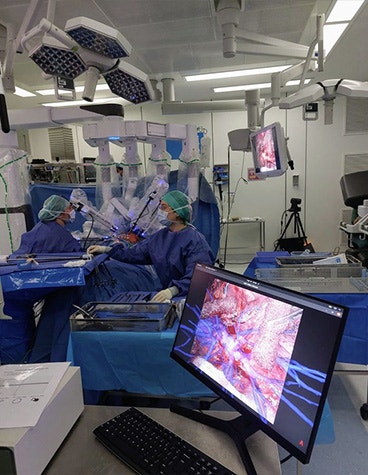
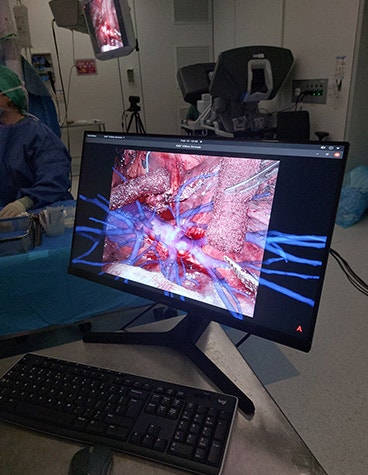
The UZ Leuven Thoracic team sees opportunities in integrating 3D planning and overlay technology with surgical robotics to further enhance surgical precision.
These emerging technologies, paired with the expertise of surgical teams, could represent the next step in advancing safety and precision for thoracic procedures, leading the way for more personalized, effective patient care.
Products mentioned in this article may be ongoing research and not commercially available. Materialise medical devices may not be available in all markets because product availability is subject to the regulatory and/ or medical practices in individual markets. Please contact your Materialise representative if you have questions about the availability of Materialise medical devices in your area.
L-104739-01
Share on:


You might also like
Never miss a story like this. Get curated content delivered straight to your inbox.