
EXPERT INSIGHT
5 Key Takeaways from the April 2026 RSNA SIG CME Course
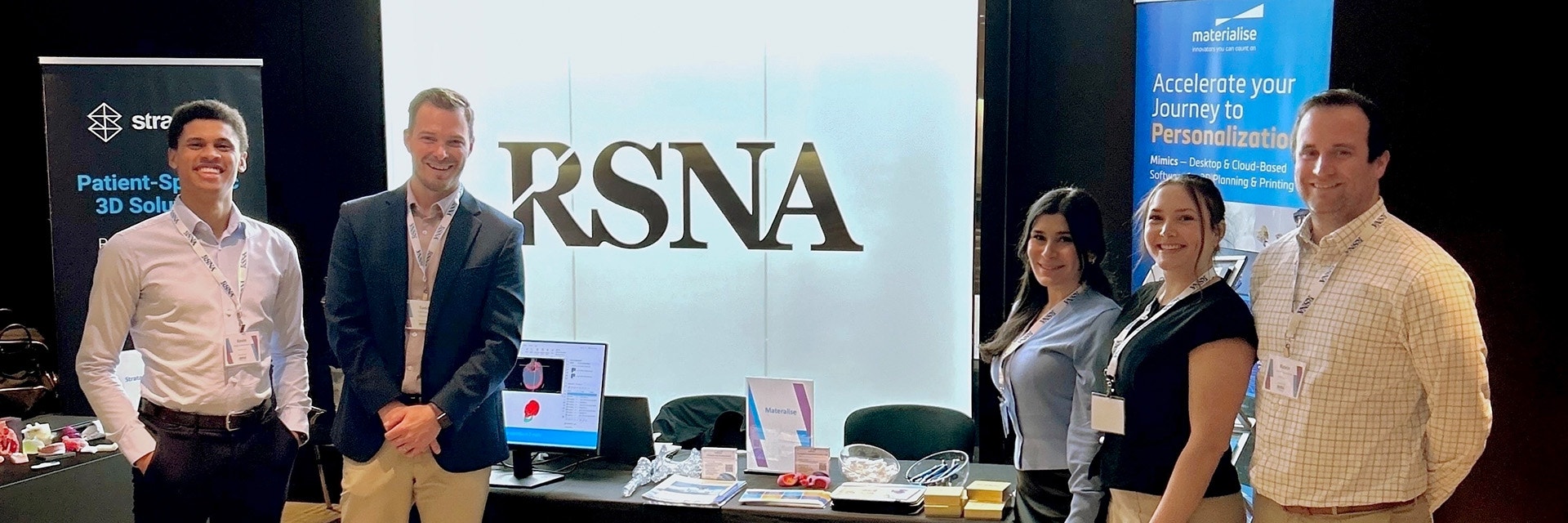

Last month’s RSNA Special Interest Group (SIG) Continuing Medical Education (CME) course made one thing clear: the future of hospitals’ in-house 3D labs is no longer defined by 3D printing alone. Across clinical, operational, and reimbursement discussions, the center of gravity is shifting toward virtual surgical planning, simulation, and 3D surface modeling. In parallel, new CPT codes and a clinical data registry will soon ease the way for widespread adoption of 3D surface modeling.
Here are five key takeaways that matter most for hospitals investing in advanced 3D surgical planning today.
1. Ask yourself, “To print or not to print?”
As Justin Ryan, PhD, Director of the 3D Innovations Lab at Rady Children’s, emphasized in his presentation, the question labs should start asking themselves is: “to print or not to print?” It’s no longer about how to 3D print, but when not to. In areas such as cardiac CT, PACS-based 3D volume rendering, surface mesh models, and extended reality (XR) are increasingly used — often for every case. On the other hand, physical prints are typically reserved for complex cases and direct surgeon requests. In many cases, virtual models deliver equal or greater value than 3D-printed models in less time and at a lower cost, making them the practical first choice for routine planning.
2. Frameworks and education are critical to scaling virtual technologies
Another recurring theme was the need for clearer guidance on which virtual technology to use and when. Surface mesh models, XR, and digital simulation used separately or in combination frequently meet clinical needs without incurring unnecessary cost or delay, but uncertainties limit their routine use. Proactively educating surgeons and care teams on these options and, importantly, aligning with appropriate-use frameworks, can normalize virtual planning and expand its adoption beyond niche cases.
3. Training programs are demonstrating how virtual planning is the future of 3D
One of the clearest signals that virtual surgical planning is ready to scale comes from formalized training programs that bridge engineering and clinical practice. Programs like Yale University’s MS in Personalized Medicine & Applied Engineering demonstrate how structured education, clinical immersion, and hands-on 3D workflows prepare the next generation of surgical planning leaders. By offering students experience in operating rooms, radiology workflows, and hospitals’ 3D labs, these programs make virtual planning a standard part of everyday clinical decision-making. As RSNA SIG speakers noted, truly investing in people through well-designed training pathways may be the fastest and most sustainable way to overcome adoption barriers and build scalable in-house 3D and virtual surgical planning capabilities.
4. The future depends on empowered, hybrid teams
Several speakers highlighted the need for a new organizational model: surgical engineering teams with varying skill sets. These teams must combine technical expertise with clinical credibility and regulatory awareness to work directly with surgeons while managing risk responsibly. Supporting these teams through standardized processes, quality management systems, and clear accountability will be essential to making virtual planning sustainable.
5. New CPT codes and a registry are a turning point
Many hospital-based 3D and virtual planning labs are still focused on building a case for continued investment in their services. They focus on softer return-on-investment metrics such as cost savings and cost avoidance, rather than direct revenue generation. While these arguments remain important, they have not always been sufficient to support long-term scale.
Perhaps the most important signal for the future is the introduction of three new Category III CPT® codes for 3D digital modeling, effective July 1, 2026. These codes explicitly cover preoperative planning, computer-assisted simulation, and computational analysis using surface mesh–based 3D models — the exact workflows emphasized throughout the SIG course. For labs that have historically relied on cross-department invoicing models in which costs remain within the hospital system, these codes represent a critical step toward strong, sustainable reimbursement pathways.
Just as importantly, a forthcoming clinical data registry will allow hospitals to document real-world utilization and outcomes. Consistent use of the new CPT codes is essential: if they are underused, they risk removal. If adopted broadly, they establish the foundation for future reimbursement, potential Category I status, and a more compelling ROI story.
In the end, the RSNA SIG CME course reinforced that virtual planning is no longer experimental: it’s foundational. With the right organizational support, standardized workflows, and active use of the new CPT codes and registry, hospitals have a real opportunity to scale safely, demonstrate value, and shape the future of surgical planning.
L-105262-01
Share on:


You might also like
Never miss a story like this. Get curated content delivered straight to your inbox.